It looks like the product you're searching for isn't available right now. But don’t worry! We have plenty of other great options for you to explore. Click the button below to browse our full selection and find the perfect fit for your needs.
Everything you need to know about cannabis terpenes, how they're produced, what each one does, and how to read your Massachusetts lab label to find the right product for you.
Justin Eppley is Co-Founder and Chief Operating Officer of Terpene Journey, where he leads data strategy, analytics, and product innovation at the intersection of consumer behavior and cannabis science. With nearly two decades of experience in data modeling, predictive analytics, and business intelligence, he has developed enterprise data solutions for Fortune 500 organizations across multiple industries.
At Terpene Journey, Justin oversees the research and data infrastructure behind proprietary customer-facing tools including Terp Genie, the Entourage Builder, and Terp Rewards. His work focuses on translating complex terpene, cannabinoid, and behavioral data into intuitive systems that help consumers make smarter, more personalized product decisions.
Driven by independent terpene research and a passion for evidence-based innovation, Justin has helped pioneer a more data-informed approach to cannabis retail. He is particularly focused on how chemical profiles, customer preferences, and real-world outcomes can be combined to improve education, discovery, and product matching at scale.
TL:DR
Terpenes are the aromatic compounds in cannabis responsible for scent, flavour, and the character of your experience.
Over 100 terpenes have been identified in cannabis, each with distinct properties.
Understanding terpenes is the most reliable way to choose products that consistently deliver the experience you're looking for, more reliable than THC percentage or Indica/Sativa labels alone.
Quick Answer: What Are Cannabis Terpenes?
Cannabis terpenes are naturally occurring aromatic compounds found in the plant's trichomes, the same resin glands that produce THC and CBD. They shape the scent, flavour, and character of each strain's effects. In Massachusetts, terpene profiles appear on licensed product lab labels, a requirement enforced by the Massachusetts Cannabis Control Commission, giving consumers a data-driven way to shop.
Introduction
If you've ever wondered why two cannabis products with identical THC percentages can feel completely different, one lifting your mood and sparking creativity, the other pulling you into deep physical relaxation, terpenes are your answer.
Terpenes are the aromatic compounds that give cannabis its extraordinary range of smells and flavours. But their role goes far beyond scent. They interact with cannabinoids to shape the overall character of your experience, acting as what many in the industry describe as the "rudder" of the cannabis high.
This guide covers everything you need to know about cannabis terpenes in 2026, from the science of how they're produced, to a full breakdown of the most important terpenes, to how to read a Massachusetts lab label and use that data to make better purchases.
Quick Steps: How to Use Terpenes to Choose Cannabis
Identify the experience you want (relaxation, focus, creativity, sleep)
Learn which terpenes are associated with that experience
Read the terpene profile on your Massachusetts lab label or use our convenient Entourage Builder, to shop by core terpene effects.
Look for a total terpene percentage of 1.5–2%+ for a high-quality product
Terpenes are synthesised in the glandular trichomes of the cannabis plant, the tiny, crystal-like resin glands visible on the flower and trim. These are the same structures responsible for producing THC and CBD, which is one reason terpene and cannabinoid content tend to correlate in quality cultivation.
Growing conditions significantly influence terpene production. Light exposure, temperature, humidity, soil composition, and harvest timing all affect the final terpene profile of a given crop. The same strain grown in different conditions, or even harvested at different times, can produce noticeably different terpene profiles and, as a result, different experiences.
Therefore, batch-specific lab data matters. A strain name alone tells you very little. The lab results from a specific harvest tell you exactly what you're getting.
Terpene Journey Insight:While a specific product may always be considered a sativa, a peek into its terpene lab data can peel back the curtain on potential reasons why it makes you feel “sedate”. It can even be a window into the freshness of a particular batch of the product – as some terpenes such as linalool are generally the final major terpene to leave cannabis. So, even when a product’s typical terpene profile aligns with what is typically considered a sativa experience (e.g., limonene-strong uplift), if the product has been stored incorrectly or is aged may have a higher percentage of only linalool left as the other, “quicker to leave” terpenes have already gone.
What Are the Most Important Cannabis Terpenes?
These are the most commonly occurring terpenes in cannabis and what the research and consumer experience suggest about each.
Myrcene
Aroma: Earthy, musky, herbal, the classic cannabis scent. Commonly associated with: Deep physical relaxation, body-heavy sensations, evening use. Found in: Mango, hops, lemongrass
Myrcene is the most abundant terpene in cannabis and the primary driver of that "couch-lock" sensation associated with many Indica-dominant strains. If you're shopping for end-of-day relaxation or sleep support, Myrcene-dominant profiles are typically your best starting point.
Limonene is the terpene most commonly associated with energising, mood-lifting cannabis experiences. It's frequently found in strains that feel functional and daytime-friendly, the kind of product you'd reach for before a creative session or social situation.
Caryophyllene
Aroma: Spicy, woody, peppery. Commonly associated with: Grounding body effects, stress relief, tension reduction. Found in: Black pepper, cloves, cinnamon
Caryophyllene is unique among cannabis terpenes because it's the only one known to interact directly with the body's endocannabinoid system, specifically CB2 receptors. It can be particularly interesting for consumers seeking body-focused relief without intense psychoactive effects.
Pinene
Aroma: Sharp pine, fresh cedar. Commonly associated with: Mental alertness, clarity, focus. Found in: Pine needles, rosemary, basil
Pinene is often found in strains that feel clear-headed and functional. Some research suggests it may counteract short-term memory impairment associated with THC, which makes it particularly relevant for consumers who want to remain sharp and productive.
Linalool, a primary aroma compound, shares a long history of use for calming and sleep with lavender. In cannabis, Linalool-dominant profiles are typically chosen for anxiety relief and evening wind-down.
Terpinolene
Aroma: Piney, floral, herbal, slightly complex. Commonly associated with: Mild uplifting effects, creative states. Found in: Nutmeg, tea tree, apples
Bisabolol
Aroma: Soft floral, sweet, slightly honeyed, with hints of chamomile. Commonly associated with: Gentle calming effects, skin-soothing properties, anti-irritant qualities. Found in: Chamomile, candeia tree, sage
Bisabolol is one of the more understated cannabis terpenes, but it's well known in the wellness world for its calming, skin-friendly properties. In cannabis, it tends to appear as a supporting terpene rather than a dominant one, and is often associated with mellow, soothing experiences. Consumers seeking softer, more body-balanced effects without sharp stimulation may find Bisabolol-rich profiles particularly appealing.
Humulene shares its name with Humulus lupulus (the hop plant), and brings that same earthy, beer-like depth to many cannabis strains. It rarely takes the lead in a terpene profile but plays a key supporting role, often contributing to the grounded, settled character of certain Indica and hybrid varieties. It's a useful terpene to look out for if you're building a profile around calm, balanced effects rather than intensity.
How to Read a Massachusetts Cannabis Lab Label
Massachusetts state regulations, enforced by the Massachusetts Cannabis Control Commission, require all licensed cannabis products to undergo rigorous third-party laboratory testing, with results displayed on product packaging. Here's what to look for:
THC % - The percentage of delta-9 THC by weight. A useful but incomplete picture on its own.
CBD % - Often low in recreational flower, but relevant in balanced or therapeutic products.
Total Terpene % - Look for this figure. A total terpene content of 1.5–2% or above indicates a flavourful, high-quality product with a meaningful terpene profile. The total terpene content is a figure most customers overlook entirely.
Individual Terpene Breakdown - The top three to five terpenes are typically listed by concentration. The dominant terpene, the one listed first, has the greatest influence on your experience.
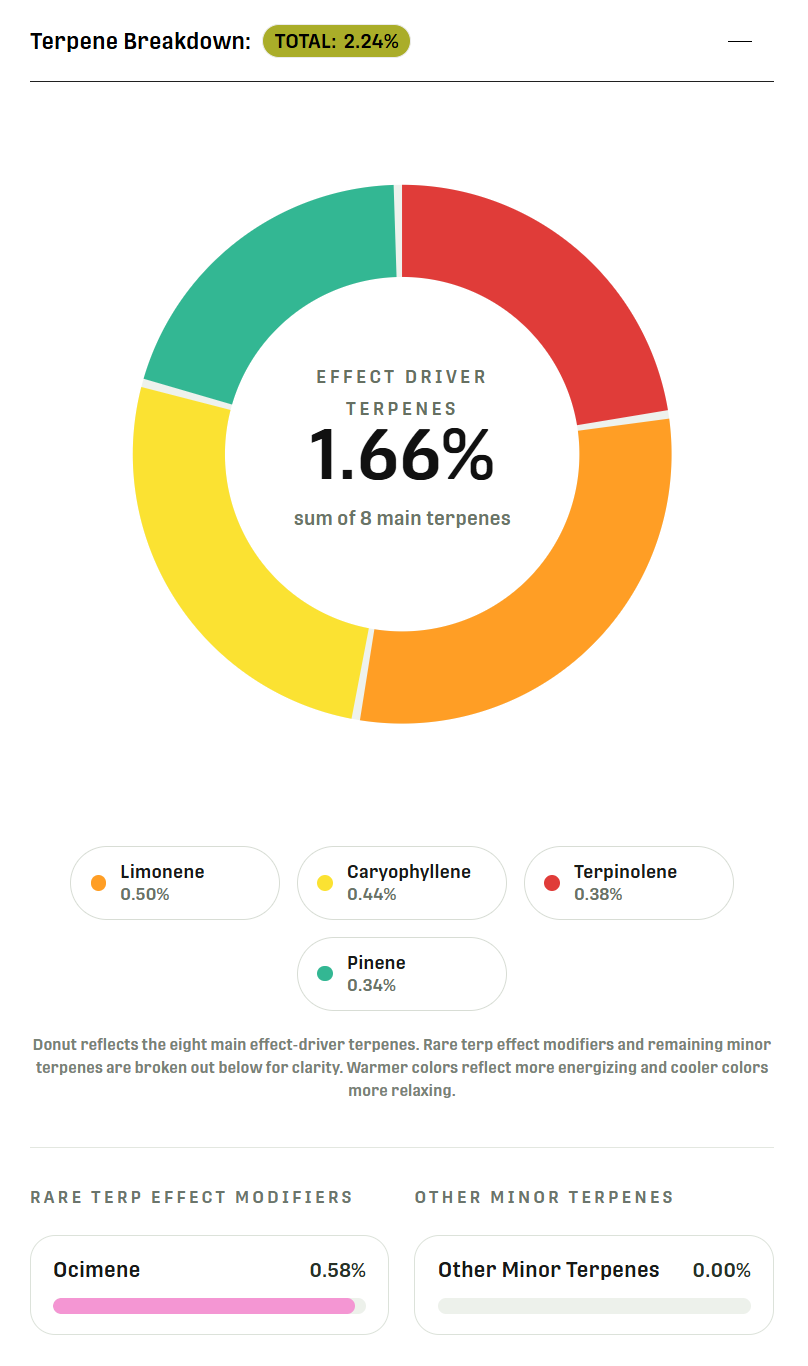
Terpene Journey Insight:It’s also important to consider the terpene profile in whole. While limonene may be the most dominant terpene, the experience from customers has shown that products with limonene both in the first position but one with linalool almost as strong can cancel out some of the raciness of highs. For this, we recommend viewing the complete terpene breakdown found on each of our product pages underneath the heading titled “Entourage Effect Detail”. Many of our customers report viewing the balance of colors in the terpene wheel has helped them navigate product decisions with more precision, ease, and confidence in their choice.
What Is the Entourage Effect in Cannabis?
The entourage effect is the widely discussed theory that cannabis compounds, cannabinoids, terpenes, and flavonoids work together to produce a more nuanced experience than THC in isolation. Rather than a single compound driving the entire effect, the strain's full chemical profile shapes the experience.
Research into the entourage effect is ongoing, and individual responses vary. However, many consumers report that full-spectrum products, those that preserve the complete terpene and cannabinoid profile, feel more rounded and predictable than isolated or distillate-based products.
How Are Terpenes Preserved Across Different Product Types?
Not all cannabis products preserve terpenes equally. The extraction or processing method significantly affects how much of the original terpene profile survives in the final product.
Putting Terpene Science Into Practice at Terpene Journey
Understanding terpenes is one thing; finding the right product based on that knowledge is another. At Terpene Journey, we built Terp Genie™ specifically to bridge that gap.
Rather than relying on generic strain names or broad Indica/Sativa labels, Terp Genie™ analyses batch-specific lab data across our inventory in real time, assigning every product a confidence score from 1 to 99 based on how it actually performs, not just what it's called. The result is a "living menu" that evolves with every new harvest, so the recommendations you see reflect the current batch rather than a historical average.
For Terp Club members, Terp Genie™ goes further still, learning your individual preferences over time from your feedback and refining future recommendations accordingly.
It's the most direct application of the terpene science covered in this guide, applied to the specific products available to you right now.
Key Terpene Concepts Explained
Terpene Profile: The unique combination and concentration of terpenes present in a specific cannabis strain or product batch. Two products with the same strain name can have meaningfully different terpene profiles depending on growing conditions, harvest timing, and processing, which is why batch-specific lab data is always more reliable than strain names alone.
Total Terpene Percentage: A figure on Massachusetts lab labels representing the combined concentration of all measured terpenes. Products with 1.5–2%+ total terpenes are generally considered high-quality and flavourful. This figure is separate from and often more informative than THC percentage in predicting the character of an experience.
Terpene Degradation: The process by which terpenes break down due to exposure to heat, light, oxygen, or time. Because terpenes are volatile compounds, improper storage can significantly reduce both the flavour and effect of a product. Cool, dark, airtight storage slows this process considerably.
Full-Spectrum: A term describing cannabis products that retain the complete range of cannabinoids and terpenes from the original plant. Unlike isolates or distillates, full-spectrum products preserve the natural chemical complexity believed to drive the entourage effect, producing a more rounded, nuanced experience.
Batch-Specific Lab Data Laboratory test results tied to a specific harvest or production batch, rather than averaged across multiple harvests. Because terpene profiles vary between batches of the same strain, batch-specific data is the most accurate indicator of what a product actually contains and how it is likely to feel.
Summary:
Key Takeaways
Terpenes are produced in the same trichomes as THC and CBD, and growing conditions and harvest timing significantly shape their concentrations.
The six most important cannabis terpenes are Myrcene, Limonene, Caryophyllene, Pinene, Linalool, and Terpinolene, each associated with distinct effects.
Massachusetts lab labels include terpene data, mandated by the Cannabis Control Commission. Look for a total terpene % of 1.5–2%+ and read the dominant terpene first.
The entourage effect suggests cannabinoids and terpenes work together; full-spectrum products tend to feel more nuanced than isolated THC.
Product type significantly affects terpene preservation; live resin and fresh flower retain the most; distillates are the most variable.
Strain names are unreliable guides to effect; batch-specific terpene data is the only way to know what you're actually buying.
Share this story with friends and family:
FAQs
Terpenes are naturally occurring aromatic compounds produced in cannabis trichomes. They're responsible for the plant's scent and flavour, and are believed to influence the character of the cannabis experience by interacting with cannabinoids. In Massachusetts, the Cannabis Control Commission requires licensed products to list terpene profiles on lab labels.
Over 100 terpenes have been identified in cannabis, though most products are dominated by a handful, typically Myrcene, Limonene, Caryophyllene, Pinene, Linalool, and Terpinolene. The dominant terpene has the greatest influence on the experience.
A total terpene percentage of 1.5–2% or above on a Massachusetts lab label is generally considered high quality and indicates a flavourful, aromatic product with a meaningful terpene profile. This figure appears on all licensed Massachusetts cannabis packaging.
Yes. Terpenes are volatile compounds that break down when exposed to heat, light, and oxygen. Storing cannabis in a cool, dark, airtight container significantly slows this process and preserves both flavour and effect.
No. Because terpene production is influenced by growing conditions, harvest timing, and processing, the same strain can produce different terpene profiles across different batches. Batch-specific lab data is always more reliable than strain names alone.
By using this website, you agree to the storing of cookies on your device to enhance site navigation, analyze site usage, and assist in our marketing efforts. View our Privacy Policy for more information.








.svg)